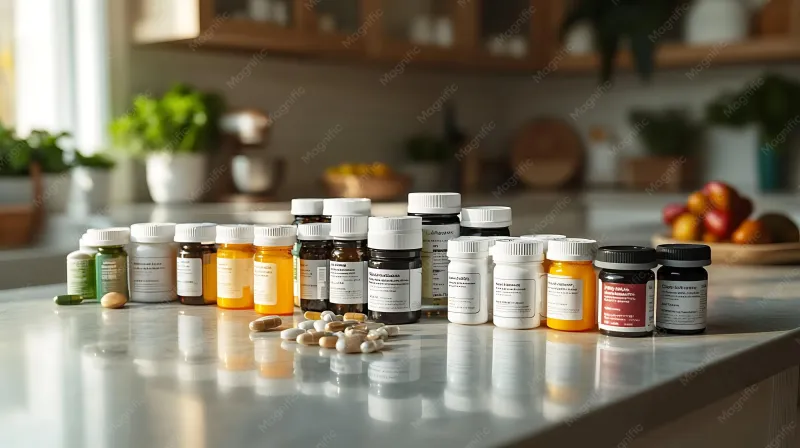
Two Capsules, One Dose: Decoding the Math on Your Supplement Label

Photo by Photo by Kelly Sikkema on Unsplash on Unsplash
Here is a small experiment you can run in about ninety seconds. Grab any supplement bottle from your kitchen and answer three questions: how much of the active ingredient is in one serving, how many servings are in the bottle, and how many capsules do you actually swallow to get one serving? If you had to squint at the back panel to answer, you are in good company. The labeling is legal. It is just not especially interested in helping you.
Serving size is the quietest number on the bottle and the one that moves the price the most. And in a market where a 2026 shopper can compare sixty brands in a browser tab, knowing how the math works is the difference between buying a dose and buying a promise.
The label is accurate. Your assumption is the problem.
A supplement can say one serving and mean anything from a single capsule to four tablets to a level scoop to a two-ounce pour. Nothing on the front of the bottle has to match the back. A product shouting 500 mg in big type might be describing one capsule, or two, or six.
The number that actually matters is servings per container. A bottle with 120 capsules and a two-capsule serving holds 60 servings, not 120. That is a completely legal way to sell what feels like a four-month supply that is really a two-month supply. Push the serving to three or four capsules and the bottle in your hand evaporates twice as fast as the price tag suggested.
Run it on a real bottle. Say it costs $22 and holds 90 capsules. If one capsule is a serving, you are paying about 24 cents a day. If the serving is three capsules, that same bottle costs you 73 cents a day. Same shelf, same logo, triple the daily price.
Elemental weight versus the stuff it is wrapped in
Once serving size is clear, the next trap is what those milligrams describe. Some nutrients arrive attached to a carrier molecule, and labels do not always make the distinction obvious.
Fish oil is the classic case. A softgel marketed as 1,000 mg is usually 1,000 mg of total oil, commonly landing around 180 mg of EPA and 120 mg of DHA, with the rest being other fatty acids. Two products can both print 1,000 mg and deliver wildly different amounts of the thing you came for. Compare the EPA plus DHA number, then divide price by it to get cost per gram of what matters.
Botanical powders behave identically. Turmeric root powder runs a few percent curcuminoids by weight; a standardized extract can land near 95 percent. A 500 mg capsule of the powder and a 500 mg capsule of the extract share a number on the label and almost nothing else.
Then there is the proprietary blend, that polite way of saying we would rather not. One blend line gives you the combined weight of eight ingredients with no individual amounts. You cannot compare that to anything, and no amount of arithmetic fixes it. Treat blend weight as marketing weight.
Scoops measure volume. Doses measure mass.
Powder supplements add a whole extra layer, because the scoop in the tub is a volume measure and the label is a mass measure. A scoop holding roughly 12 grams of a dense protein blend may hold only 6 or 7 grams of a fluffy greens powder. If the label says a serving is 8 grams and your scoop — the one that came in the tub, or worse, the one from the drawer — holds 15, you have been running somewhere between half and double. Either way, you are not taking what you think.
The fix costs about twelve dollars. Buy a small kitchen scale, tare the scoop, weigh one serving until you know what your scoop actually does in grams. Do it once and the question is dead forever.
Your bottle and the study are different universes
Read a trial on omega-3s and blood lipids and you may find 2 to 4 grams of EPA plus DHA per day. Read a standard bottle and you may find 300 mg per softgel. Nobody is lying, but the researched dose and the label dose can sit three or four times apart.
This is the most common reason people conclude a supplement did nothing. They were never anywhere near the dose that got studied. Before you judge whether something works, check whether your daily intake overlaps with the research range — then decide honestly whether the number of pills required is something you will still be doing in March. Sometimes the answer is that a capsule format makes the studied dose impractical and a powder makes more sense.
A 60-second checklist for the next bottle
Before you check out, run these six lines:
- Serving size, in capsules, tablets, or grams
- Servings per container, not capsule count
- Active amount per serving: EPA plus DHA, elemental mineral, standardized extract percentage
- Price divided by servings for the real daily cost
- Price divided by active grams for the real value
- Whether the dose you would genuinely take matches the dose anyone studied
The takeaway
Serving-size math is not a scandal. Nobody is breaking a rule. It is simply a place where a manufacturer's interests and your assumptions quietly drift apart, and where a few minutes with a calculator beats any discount code. The bottle that looks cheaper almost never is, once you divide by the thing you actually wanted.